Resource • White Paper
FROM PROMISE TO PROGRAM
Building Credible Paths to the Next Value Inflection
BASED ON A TRUE STORY
A biotech CEO walks into a fundraising meeting carrying everything they need: compelling preclinical data, a clear scientific protocol, and a program built around real therapeutic promise. For a brief moment, the science owns the room. But then the conversation shifts. Investors are no longer focused on mechanism of action or efficacy. They lean in and begin asking questions that will determine whether a scientific promise can actually be developed into a viable program:
- How quickly can you reach the next credible milestone?
- What risks could push that timeline off course?
- How confident are you that this program can deliver its next proof point?
In today’s market, this is the real evaluation. Scientific promise may open the door, but execution credibility determines which programs move forward and which do not. Across today’s capital environment, this is the real evaluation. Scientific promise may open the door, but execution credibility is increasingly what separates programs that move forward from those that do not. Science can start the conversation, but it is no longer enough to carry it. Investors, boards, and strategic partners are looking for something more concrete: evidence that a company can translate promising science into a development program capable of reaching its next meaningful milestone.1
That shift reflects a broader change in how biotech programs are being evaluated. Capital may be returning to the sector, but it still remains highly selective. Fundraising, partnering, and acquisition decisions are increasingly shaped by whether a program can generate credible data, use capital efficiently, and navigate operational risk with discipline.2
Execution does not follow strategy. Execution is strategy.
THE MARKET RESET: Why Execution Now Shapes Biotech Opportunity
The biotech market is showing signs of renewed activity, but not a return to wholesale optimism. Capital is moving, but far more selectively, and investors are applying a sharper filter to which programs deserve support. Scientific promise remains essential, but the market is now asking a harder question: can the company behind it reach the next meaningful milestone with a plan that looks feasible, disciplined, and executable? That path must be supported by disciplined planning, efficient capital use, and the operational readiness to deliver.3
Financing conditions have improved from the worst of the recent downturn, but access to capital remains inconsistent. The practical result is that the standard of evaluation has changed. Investors are not simply asking whether a therapy is innovative. They are asking whether the company behind it can reach the next proof point on time, allocate capital wisely, and manage the real-world complexities that stand between promising science and credible data. That same scrutiny now extends beyond fundraising. Strategic partners and potential acquirers are also looking more closely at whether a program appears executable, de-risked, and capable of withstanding diligence.4
Scientific promise may open the door, but execution credibility determines which programs move forward and which do not.
WHY THE EVALUATION STANDARD HAS CHANGED
What has changed is not the importance of science, but the threshold for confidence. In a more selective market, investors and strategic partners are no longer rewarding activity for its own sake. They are looking for credible progress, disciplined capital use, and a development path that can withstand scrutiny before pressure turns into delay. Recent market reporting reflects exactly that dynamic: financing conditions have improved, but access to capital remains uneven, and investors continue to favor companies that show focus, fundamentals, and resilience over ambition alone.5
One reason is that the cost of getting to the next inflection point has become much harder to ignore. In a tighter funding environment, companies are expected to show not only what they are building, but how efficiently they can move it forward. That makes capital discipline more than a financial concern. It becomes part of how leadership judgment is assessed. In other words, the market is no longer separating the science from the execution path built around it. Increasingly, both are being evaluated together.6
Another reason is that operational risk now becomes visible much earlier. Development plans are being judged not only for scientific ambition, but for feasibility. Questions around study design, trial oversight, data quality, and governance are no longer treated as downstream details. FDA guidance now explicitly emphasizes flexible, risk-based approaches to trial quality and monitoring, stating that “quality should be built into the scientific and operational design and conduct of clinical trials,” not patched in later.7
Strategic interest has also become more demanding. Whether the audience is an investor, a board, a potential partner, or a future acquirer, the expectation is increasingly the same: the program must look executable. It must show a believable path forward, a realistic understanding of risk, and a plan disciplined enough to keep the next milestone within reach. PwC’s 2025 health industries outlook points in the same direction, noting that biotech assets attracting the most attention are those with stronger revenue potential and clearer paths to market. Together, these pressures have made executability part of how value is judged.8
A credible CEO does not just defend the science.
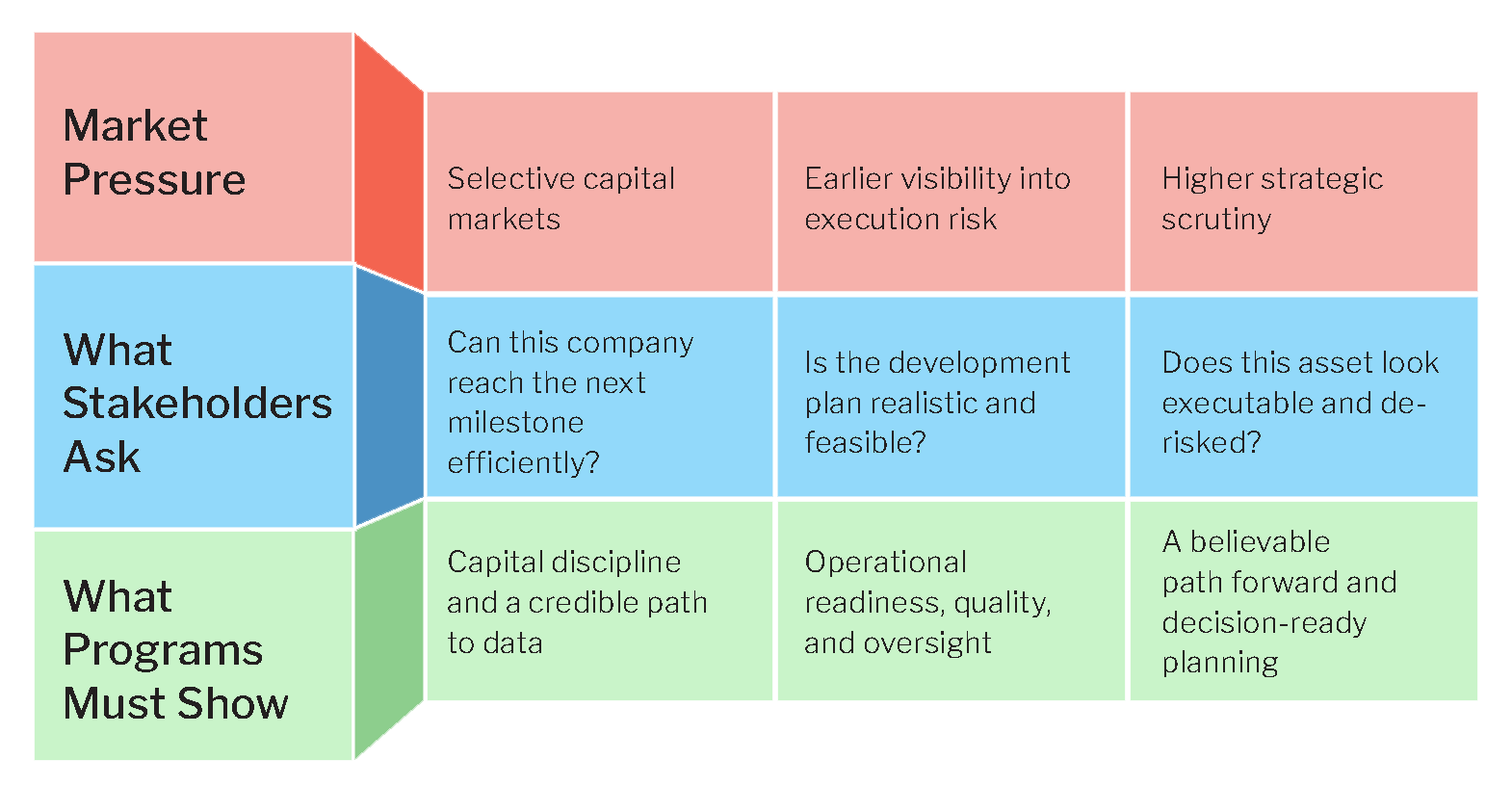
Why Execution Credibility Now Carries More Weight
A practical summary of how market pressure is changing the way biotech programs are evaluated.
THE HIDDEN RISKS THAT QUIETLY DERAIL PROGRAMS
Promising programs do not always lose momentum because the science breaks down. Just as often, they lose momentum because execution risks were underestimated early and allowed to accumulate quietly. The most damaging delays are rarely dramatic at first. They tend to surface as protocol friction, weak oversight, data questions, or operational dependencies that appear manageable until they begin pushing milestones off course.9
One of the most common problems is that protocol feasibility gets treated as a secondary issue rather than a core design principle. A study can look strong on paper and still prove difficult to execute if eligibility criteria are too restrictive, procedures are too burdensome, or site expectations are misaligned with real-world conditions. FDA guidance on protocol deviations underscores how central the protocol is to study conduct and oversight, while current good clinical practice guidance places even greater emphasis on building quality into trial design from the start. In other words, execution risk often begins long before the first patient is enrolled.10
Operational fragility also tends to hide in the handoffs between vendors, systems, and supply chains. As trials become more complex, programs depend on an increasingly interconnected set of partners, technologies, and data flows. That creates more points where delay, inconsistency, or loss of visibility can undermine progress. Deloitte’s recent biopharma analysis points to digital supply networks and stronger operational integration as essential responses to a more volatile geopolitical and operational environment. The broader lesson is that resilience has to be engineered into the overall system before pressure exposes where it is missing.11
The same is true for governance and data integrity. Regulators are increasingly clear that quality, oversight, and data reliability cannot be treated as future clean-up work. They have to be built into trial design from the outset, with documented processes, trained teams, and systems capable of managing trial data securely across its full life cycle. When governance is weak or decision-making is slow, small issues become timeline problems. When data systems are fragmented, confidence erodes quickly, and once confidence erodes, timelines, capital, and strategic interest are rarely far behind. This is what prevents operational complexity from turning into strategic delay.12
The programs that inspire confidence share a small number of characteristics that signal discipline, realism, and readiness under pressure.
FOUR SIGNALS OF AN EXECUTABLE DEVELOPMENT PROGRAM
With execution credibility now acting as a filter, the more useful question is what it looks like in practice. It does not come down to one tactic or one management decision. The programs that inspire confidence share a small number of characteristics that signal discipline, realism, and readiness under pressure.
A Clearly Defined Value Inflection
The strongest programs are organized around one milestone that truly matters. That milestone gives the development plan its center of gravity. It clarifies what evidence needs to be generated, what decisions must be made, and which tradeoffs are worth making along the way. Without that clarity, companies often diffuse effort across too many priorities and lose momentum without realizing it. A credible program does not simply pursue progress in the abstract. It is built to reach a specific proof point that meaningfully changes the company’s position with investors, regulators, partners, or acquirers.13
Development Plans Designed to Support Decisions
An executable program is not just scientifically interesting. It is designed to answer the next important question. That requires more than an elegant protocol. It requires fit-for-purpose endpoints, realistic enrollment assumptions, operational feasibility, and a study design capable of producing decision-grade evidence. Regulators are increasingly explicit that quality must be built into design from the start and that trial methods should be proportionate to the question being asked. The programs that inspire confidence are the ones that do not confuse activity with progress. They are built to support the next real decision.14
Operational Flexibility Across Vendors and Data Flows
Modern development programs do not run on science alone. They run on a web of vendors, systems, supply chains, sites, and data handoffs. That makes resilience essential. Programs become fragile when too much depends on a single vendor, a narrow data pathway, or an operational assumption that has never been tested under real pressure. By contrast, executable programs are built with flexibility. They preserve visibility across the system, reduce single points of potential failure, and create enough room to adapt quickly when conditions change. In a volatile operating environment, resilience is not a luxury. It is part of what makes a program credible.15
Governance That Accelerates Decisions
Strong governance does not slow a program down. It keeps the program moving when complexity starts to build. Clear accountability, timely escalation, risk-based oversight, and disciplined decision-making are all part of what makes execution credible. Regulators now place even greater emphasis on proportionate quality management, trial oversight, and data reliability across the full trial life cycle. That matters because when governance is weak, small issues linger long enough to become delays. When governance is strong, risks are identified early, decisions are made faster, and confidence in the program holds up.16
Four Signals of an Executable Development Program
A key analysis for understanding robust biotech program credibility
Clearly Defined Value Inflection
Organized around one milestone that truly mattersDevelopment Plans Designed to Support Decisions
Built to generate decision-grade evidenceOperational Flexibility Across Vendors and Data Flows
Structured to reduce fragility and preserve resilienceGovernance That Accelerates Decisions
Designed to surface risk early and keep momentum intactTHE LEADERSHIP IMPERATIVE
This is now a leadership test. Not a science test. Not a narrative test. In this market, biotech leaders are judged on whether they can define the next value inflection with precision, align the organization around it, and deliver. They are also judged on whether they can do so without wasting time, capital, or credibility. Regulators are pushing sponsors toward more disciplined, risk-based quality management, while dealmakers are placing a premium on derisked innovation and clearer paths to market. The message is no longer subtle. Execution does not follow strategy. Execution is strategy.17
That changes the mandate. Leadership is no longer about keeping every option alive for as long as possible. It is about making hard choices early enough to matter. It requires leaders to enforce clarity, own tradeoffs, and make decisions before ambiguity hardens into delay. A credible CEO does not just defend the science. A credible CEO can state, without hedging, what the next proof point is, why it matters, what could delay it, and what has already been done to keep that risk from becoming the story. Execution credibility is cumulative. Confidence is built over time, through the decisions a company makes and the signals a program sends at every stage. Strong leaders do not wait for friction to expose weakness. They build organizations that can absorb friction without losing momentum.
That is the real imperative now. Biotech leaders do not need to become less ambitious. They need to become more exacting, more disciplined, and more honest about what execution actually requires. That means being clear about the milestone that matters most, the risks most likely to delay it, the assumptions that have actually been tested, and whether the organization is built to perform under real-world conditions rather than ideal ones. In a market that increasingly rewards credible progress over theatrical progress, leadership is no longer defined by how convincingly a company can describe the future. It is defined by whether the company can reach the future it is describing.18

WHAT TURNS PROMISE INTO PROGRESS
Scientific innovation remains the foundation of biotech, but in today’s market, promising science alone is no longer enough. The programs most likely to attract capital, strategic interest, and sustained confidence are the ones that pair strong science with a credible path to execution. They know what milestone matters next, what could derail it, and what it will take to deliver under real-world conditions. Execution credibility is no longer a secondary operational concern. It is a strategic asset that shapes how programs are judged, how leaders are evaluated, and how value is assigned. Ultimately, that is what turns scientific promise into an executable program and gives a company a stronger basis for earning capital and confidence.
FURTHER PERSPECTIVES
To hear more from today’s biotech leaders on execution credibility, leadership, and what it takes to move promising science forward, explore these recent Few & Far Between podcast conversations:
Aoife Brennan, President of Climb Bio
Discusses efficient execution and why courage remains essential for biotech leaders navigating an increasingly demanding environment.
Amit Etkin, Founder and CEO of Alto Neuroscience
Reflects on the differences between clinical trials in academic and private-sector settings, and on the challenge of balancing scientific rigor with leadership demands.
REFERENCES
1. Ernst & Young LLP. EY Biotech Beyond Borders Report 2025: Focus on Fundamentals to Bounce Back. 18 June 2025, www.ey.com/en_us/newsroom/2025/06/ey-2025-biotech-beyond-borders-report-biopharma.
2. Ernst & Young LLP. Global IPO Trends Q3 2025. 8 Oct. 2025, www.ey.com/content/dam/ey-unified-site/ey-com/en-gl/insights/ipo/documents/ey-gl-global-ipo-trends-report-q3-10-2025.pdf.
3. Ernst & Young LLP. Global IPO Trends Q3 2025. 8 Oct. 2025, www.ey.com/content/dam/ey-unified-site/ey-com/en-gl/insights/ipo/documents/ey-gl-global-ipo-trends-report-q3-10-2025.pdf.
4. U.S. Food and Drug Administration. E6(R3) Good Clinical Practice. 8 Sept. 2025, www.fda.gov/regulato-ry-information/search-fda-guidance-documents/e6r3-good-clinical-practice-gcp.
5. Ernst & Young LLP. EY Biotech Beyond Borders Report 2025: Focus on Fundamentals to Bounce Back. 18 June 2025, www.ey.com/en_us/newsroom/2025/06/ey-2025-biotech-beyond-borders-report-biopharma.
6. Ernst & Young LLP. EY Biotech Beyond Borders Report 2025: Focus on Fundamentals to Bounce Back. 18 June 2025, www.ey.com/en_us/newsroom/2025/06/ey-2025-biotech-beyond-borders-report-biopharma.
7. U.S. Food and Drug Administration. E6(R3) Good Clinical Practice. 8 Sept. 2025, www.fda.gov/regulato-ry-information/search-fda-guidance-documents/e6r3-good-clinical-practice-gcp.
8. PricewaterhouseCoopers. Global M&A Trends in Health Industries: 2025 Outlook. 28 Jan. 2025, www.pwc.com/gx/en/services/deals/trends/2025/health-industries.html.
9. U.S. Food and Drug Administration. Protocol Deviations for Clinical Investigations of Drugs, Biological Products, and Devices. 30 Dec. 2024, www.fda.gov/regulatory-information/search-fda-guidance-docu-ments/protocol-deviations-clinical-investigations-drugs-biological-products-and-devices.
10. U.S. Food and Drug Administration. Protocol Deviations for Clinical Investigations of Drugs, Biological Products, and Devices. 30 Dec. 2024, www.fda.gov/regulatory-information/search-fda-guidance-docu-ments/protocol-deviations-clinical-investigations-drugs-biological-products-and-devices.
11. Deloitte. “Trends Shaping Biopharma in 2025.” Deloitte Insights, 10 July 2025, www.deloitte.com/us/en/Industries/life-sciences-health-care/blogs/health-care/trends-shaping-biopharma.html.
12. U.S. Food and Drug Administration. A Risk-Based Approach to Monitoring of Clinical Investigations: Ques-tions and Answers. 5 Nov. 2024, www.fda.gov/regulatory-information/search-fda-guidance-documents/risk-based-approach-monitoring-clinical-investigations-questions-and-answers.
13. U.S. Food and Drug Administration. Interacting with the FDA on Complex Innovative Trial Designs for Drugs and Biological Products. 8 Apr. 2024, www.fda.gov/regulatory-information/search-fda-guid-ance-documents/interacting-fda-complex-innovative-trial-designs-drugs-and-biological-products.
14. U.S. Food and Drug Administration. E6(R3) Good Clinical Practice. 8 Sept. 2025, www.fda.gov/regulato-ry-information/search-fda-guidance-documents/e6r3-good-clinical-practice-gcp.
15. U.S. Food and Drug Administration. Conducting Clinical Trials with Decentralized Elements. Sept. 2024, www.fda.gov/media/167696/download.
16. U.S. Food and Drug Administration. A Risk-Based Approach to Monitoring of Clinical Investigations: Ques-tions and Answers. 5 Nov. 2024, www.fda.gov/regulatory-information/search-fda-guidance-documents/risk-based-approach-monitoring-clinical-investigations-questions-and-answers..
17. U.S. Food and Drug Administration. E6(R3) Good Clinical Practice. 8 Sept. 2025, www.fda.gov/regulato-ry-information/search-fda-guidance-documents/e6r3-good-clinical-practice-gcp.
18.Ernst & Young LLP. EY Biotech Beyond Borders Report 2025: Focus on Fundamentals to Bounce Back. 18 June 2025, www.ey.com/en_us/newsroom/2025/06/ey-2025-biotech-beyond-borders-report-biopharma.
