Resource • White Paper
CULTURE AS A CLIENT DELIVERABLE
Why Team Stability Has Become Integral to Study Execution
Sponsors rarely ask a CRO to define its culture. But they experience it directly through responsiveness, continuity, accountability, and how teams perform under pressure. — Cathy Gooch, CRO Industry HR Leader
Sponsors may not openly use the word “culture,” but it sits at the core of the questions they care about most. Who will run the study? How long have they been with the company? What will protect execution if the team changes? They may not call it culture, but it is often one of the most telling signals they read in a potential partner.
Those questions place culture much closer to study execution than many organizations care to admit. FDA’s final E6(R3) guidance states that individuals involved in a trial should be qualified by education, training, and experience, and that quality should be built into the scientific and operational design and conduct of clinical trials. The same framework also makes clear that sponsors remain responsible for trial-related activities and data reliability even when work is delegated to Contract Research Organizations (CROs) and other service providers. Once those expectations are taken seriously, workforce conditions stop looking like a background HR issue. They become part of delivery.
Clinical execution depends on capable people, clear accountability, sound judgment, and effective oversight. When those elements weaken, a study may still move forward, but with more friction, more preventable handoffs, and more pressure on communication and decision-making. Culture is not a guarantee of study success. It does, however, influence whether the conditions for strong execution stay intact over time.1
In a CRO setting, culture needs a disciplined definition. It is not office atmosphere. It is not branding language. It is the operating environment that shapes how people work, how teams stay aligned, and how execution holds up over time. That includes the management habits that set expectations and reinforce accountability. It includes communication practices that keep decisions clear and issues visible before they become delays. It includes development structures that help people build skills, grow into larger roles, and remain engaged in the work. It also includes workforce planning decisions that determine whether staffing is reactive or whether the organization is prepared before pressure builds.
Cathy Gooch, an HR leader with 25 years of experience in the CRO industry, explains that “culture inside a CRO becomes visible in the everyday decisions teams make, how they escalate issues, how they support one another, how they engage sites, and how consistently they execute over the life of a study.” In practice, that means:
- managers who give people clarity, feedback, and support
- onboarding that helps new team members contribute quickly without creating avoidable drag on the rest of the study team
- role design that creates room for growth instead of leaving strong employees stalled in place
- staffing decisions that anticipate study needs early, not only after gaps appear
- transition practices that preserve knowledge, maintain momentum, and protect execution rather than forcing teams to start over every time a role changes
This view of culture also fits the current regulatory environment. FDA’s risk-based monitoring guidance states that the goal of modern monitoring is to enhance human subject protection and data quality by focusing oversight on the aspects of study conduct and reporting that matter most. ICH E8(R1) similarly emphasizes designing quality into clinical studies from the outset and identifying the factors critical to study quality during planning, then managing risks to those factors throughout conduct. Together, these frameworks point to the same operational truth. Quality is not only a matter of protocol design or compliance systems. It also depends on whether the people responsible for execution are qualified, supported, and able to perform well over time. 1
Culture inside a CRO becomes visible in the everyday decisions teams make, how they escalate issues, how they support one another, how they engage sites, and how consistently they execute over the life of a study.
Workforce disruption rarely announces itself as a single dramatic event. More often, it shows up gradually in the day-to-day mechanics of study delivery. Escalations take longer. Communication becomes less consistent. Knowledge has to be transferred more than once, and decisions that once moved quickly begin to slow. Sponsor and site relationships can also feel the strain, especially when new points of contact have to be brought up to speed while the study is already in motion. None of these issues automatically derail a trial. But taken together, they can weaken execution where responsiveness, judgment, and coordination matter most. Team retention should not be viewed only as an HR metric. It is also a signal of whether a CRO has built a system strong enough to protect delivery.123
As Gooch notes, “every transition carries hidden operational costs. When key team members leave mid-study, sponsors lose more than continuity. They also lose historical context, site relationships, and momentum.”
A broader body of evidence supports the workforce side of this argument. Gallup continues to report that managers account for 70% of the variance in team engagement. Its January 2026 update found that U.S. employee engagement averaged 31% in 2025, unchanged from 2024 and still below the 2020 peak. Together, these findings reinforce an important point that holds across settings: manager quality is not incidental to retention or performance.45
Managers shape many of the conditions that determine whether execution remains strong over time. They set expectations, create clarity, surface problems early, and influence whether people feel supported enough to stay and perform well under pressure. Strong management is not simply a people issue. It is part of what helps execution stay steady when a study is under pressure.
Clinical research workforce studies point in the same direction. A peer-reviewed study of clinical research professionals found that turnover decreased from 23% to 16% after implementation of a competency-based job framework. A later workforce analysis found that voluntary turnover peaked during the pandemic and then declined, with the authors concluding that proactive workforce standardization may have helped prevent more severe instability. These studies were conducted in academic medical center settings rather than CROs. Even so, they reinforce a point that extends beyond any single setting. Workforce design matters.
Every transition carries hidden operational costs. When key team members leave mid-study, sponsors lose more than continuity. They also lose historical context, site relationships, and momentum.
Role clarity, defined development pathways, and structured support can improve retention in clinical research operations. Staffing and workforce resilience are not the same thing. Reactive hiring can fill vacancies, but it cannot by itself preserve institutional knowledge, maintain manager trust, or protect cross-functional rhythm. As Gooch puts it, “filling a vacant role solves an immediate staffing need, but culture is what helps retain people and build workforce resilience. That resilience creates the stability, engagement, and institutional knowledge needed to sustain study execution over time.” A stronger delivery model does more than replace departing people. It anticipates demand, develops bench strength in critical roles, supports cross-training where appropriate, and reduces the chance that key functions become single points of failure. The issue is not simply whether a team can be assembled. It is whether that team can remain effective long enough to execute well.67
External industry signals reinforce that staffing pressure remains a live issue across the clinical research ecosystem. Recent CTTI materials identified staff turnover as one of the challenges reported across participating site types. That does not prove that one CRO’s internal culture determines study outcomes. It does, however, strengthen the broader point that workforce durability remains part of the environment in which trials are delivered. Sponsors are justified in asking not only whether a partner can staff a study on day one, but whether that partner can sustain performance as the study progresses.
WHAT SPONSORS SHOULD LOOK FOR IN A CRO PARTNER
For sponsors, the useful question is not whether a CRO speaks well about culture. The better question is whether it shows up in how the work gets done. Does it help sustain strong teams, protect continuity, and support reliable execution over time? Sponsors should look beyond whether a partner can staff a study at the outset and ask how that partner keeps performance strong over time. That means understanding how key roles are supported, how managers help retain and guide strong teams, how knowledge is carried through transitions, and how openly the CRO communicates staffing changes that could affect execution.
That discussion should lead to questions such as:
- How do you plan retention for critical study roles?
- What happens when a key team member leaves mid-study?
- How do you preserve knowledge across handoffs?
- How do you prepare managers to reduce avoidable turnover?
- How do you align staffing with expected study demand?
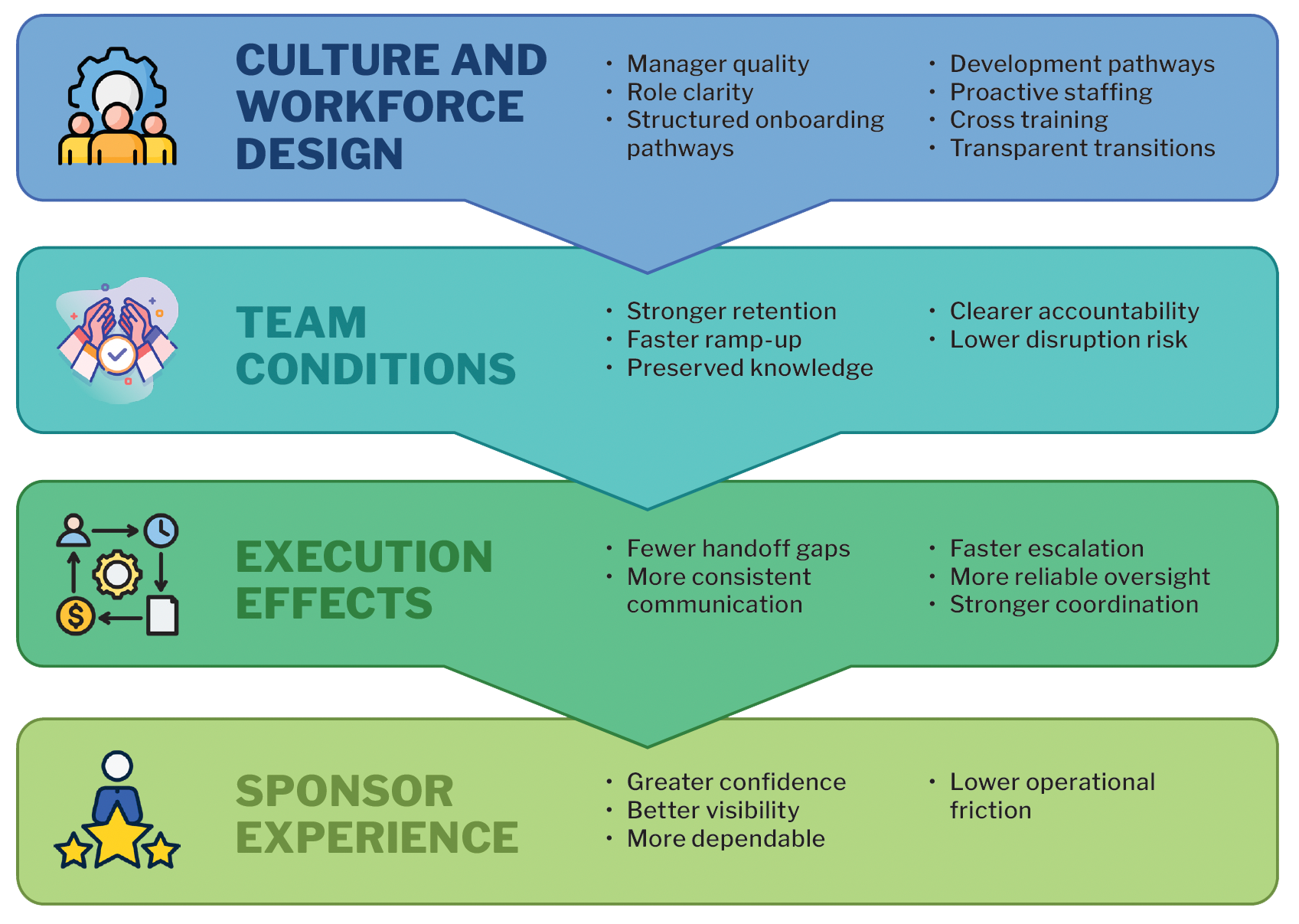
CULTURE IN ACTION: FROM WORKFORCE DESIGN TO SPONSOR EXPERIENCE
One way to understand this relationship is to view culture not as an abstract internal value, but as a practical force in how a study is delivered.
This progression does not suggest that culture alone determines study outcomes. It does show why culture belongs in the delivery conversation. What begins as an internal management and workforce issue becomes visible to sponsors in the form of coordination, responsiveness, and confidence in the team executing the trial.
These are not peripheral workforce questions. They get to the heart of whether a CRO has built an environment that can support oversight, preserve knowledge, and keep execution steady over the life of a study. They also reveal how the organization performs when pressure rises, staffing shifts, or critical decisions need to happen quickly. That is where culture becomes visible to sponsors, not as an internal message, but in how well the work holds together.
For sponsors, culture becomes part of the risk, quality, and delivery equation. A team that is well supported and prepared for transitions is better positioned to maintain momentum, make sound decisions, and sustain trust across the life of the study.123
For CROs, the message is just as important. Culture should not be framed only as an inward-facing employer story. It should be understood as part of the delivery model itself. Sponsors experience it in the steadiness of the team, the quality of communication, the continuity of knowledge, and the confidence that the work will hold together under pressure.
Workforce decisions cannot be treated as separate from execution decisions. The way a CRO develops managers, supports teams, plans staffing, and handles transitions shapes the sponsor experience in tangible ways. When those elements are strong, the result is more than a healthier internal environment. It is a study team better able to maintain momentum, exercise sound judgment, and sustain trust across the life of a trial.
Culture shapes behavior and drives results. It is how work gets done when no one is watching.
Cathy Gooch, CRO Industry HR
That is what makes culture more than an internal value. It becomes part of what clients experience, rely on, and remember.
Sponsors may not buy it by name, but they feel it in coordination, responsiveness, retained knowledge, and confidence in the team running the study. In an industry where quality, oversight, and reliability are constantly tested, those conditions matter. At its best, culture helps hold execution together. That makes it part of the deliverable.

A FURTHER PERSPECTIVE
Gooch C. “Top Tips for Taming CRO Turnover.” Biorasi, August 14, 2023. Internal contextual source that informed the broader framing around sponsor concern, team retention, communication, and proactive planning.
REFERENCES
1. U.S. Food and Drug Administration. E6(R3) Good Clinical Practice: Guidance for Industry. September 2025.
2. U.S. Food and Drug Administration. Oversight of Clinical Investigations — A Risk-Based Approach to Monitoring: Guidance for Industry.
3. International Council for Harmonisation. ICH E8(R1) General Considerations for Clinical Studies.
4. Gallup. How to Engage Frontline Managers.
5. Gallup. U.S. Employee Engagement Declines From 2020 Peak. January 2026. Post-cutoff; verified live March 31, 2026.
6. Stroo M, Asfaw S, Deeter PJ, et al. “Impact of Implementing a Competency-Based Job Framework for Clinical Research Professionals on Employee Turnover.” Journal of Clinical and Translational Science. 2020.
7. Stroo M, Carson S, Deeter PJ, et al. “Trends in Turnover and Turbulence at a Large Academic Medical Center Before and During COVID-19: Analyzing Structured Clinical Research Professional Roles.” Journal of Clinical and Translational Science. 2025. Post-cutoff; verified live March 31, 2026.
8. Clinical Trials Transformation Initiative. Project Watchtower Expert Meeting Slides, Day 2. 2025. Post-cutoff; verified live March 31, 2026.
