Resource •
PROOF OVER PROMISES
Why FIH-to-POC Progress Depends on Decision-Ready Execution
A sponsor team leaves an early dose review meeting thinking the study is ready to move forward. The first part of the program is complete. The protocol is active. Initial safety data is in hand. No setbacks. The science still looks strong.
On paper, the program appears to be on track. The next step looks clear: open the next cohort, bring patients into the study, and stay on course toward proof of concept. Then the conversation shifts from what the program has shown so far to whether it is ready for what comes next.
- How fast can patient cohorts open?
- Is safety data clean enough to act on?
- When will pharmacokinetic data (PK) be available?
- Will hybrid execution hold up?
- Can the program move without delay?
This is where many early-phase programs begin to stall. Not because the science has failed. Not because the protocol is no longer viable. But because the bridge from First-in-Human (FIH) to Proof-of-Concept (POC) is less prepared than it first appears.
What begins as an execution issue rarely stays contained. At this stage, even a narrow breakdown in readiness can affect timelines, confidence, and the perceived credibility of the path forward. That matters more now because both regulatory expectations and market conditions place greater weight on execution discipline than they once did.
Recent regulatory guidance helps explain why. The guidance emphasizes flexible, risk-based approaches and quality built into trial design from the outset. FDA’s guidance on decentralized elements points in a similar direction. Distributed trial activities require deliberate planning, clear responsibility, and fit-for-purpose oversight.
ICH E8(R1) reinforces the same logic by emphasizing study design around defined objectives and early identification of factors critical to study quality. The market reinforces the same message. EY’s 2025 biotech report describes a capital environment that remains selective and shaped by continued pressure on fundamentals. In that setting, execution discipline is harder to separate from development credibility. A program that looks scientifically sound but operationally underprepared can lose momentum faster than teams expect.
FOUR REASONS PROGRAMS STALL BETWEEN FIH AND POC
A practical view of where early-phase momentum breaks down when execution is not built to support the transition from First-In-Human to Proof of Concept.
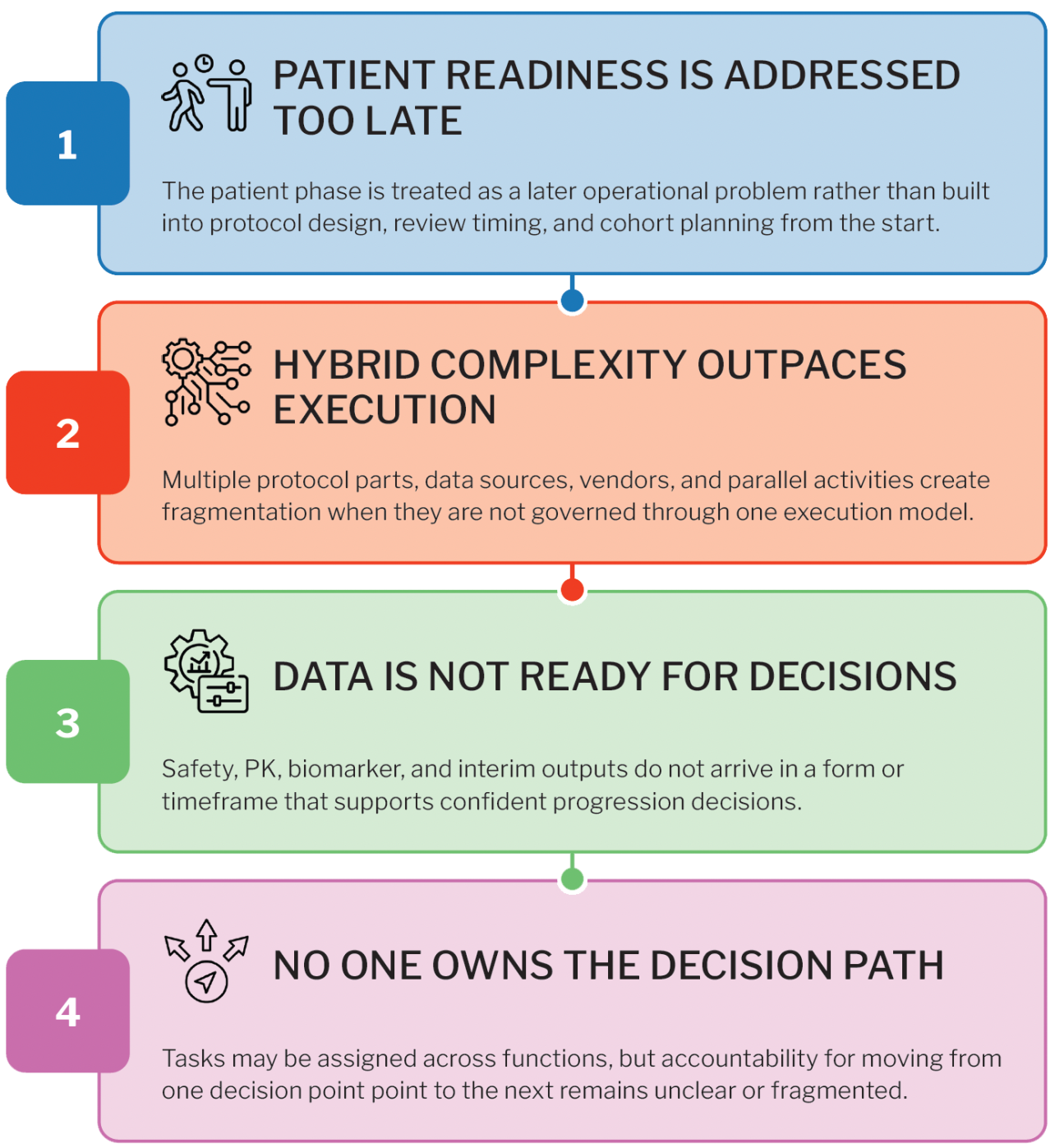
What looks like momentum can still be only partial readiness.
WHEN PATIENT READINESS IS DEFERRED
In many early development programs, patient access is addressed too late. The work begins, the healthy-volunteer cohort moves forward, and only then does attention turn to the practical demands of opening and managing patient cohorts. By that point, some of the most important decisions have already been made. The issue is not only whether patients can eventually be found. It is whether the program has been designed so patient cohorts can open when the decision window arrives.
For that reason, patient access should not be viewed only as a recruitment challenge. It is also a study-design issue, a data-timing issue, and an execution issue. It begins with whether the protocol is realistic for the population. It depends on patient burden, assessment timing, safety review cadence, and whether assumptions made during healthy-volunteer planning remain valid once patients enter the program. It also depends on whether interim information can be generated quickly enough to support patient-entry decisions.
Patient readiness is built before enrollment becomes the visible problem. When the protocol is not designed realistically, friction is likely to surface later as slower cohort activation, added protocol strain, or pressure on review and decision timelines.
Current regulatory thinking supports that broader view. ICH E8(R1) places study design within the larger context of development planning and emphasizes rigorous design around study objectives and reliable results. FDA’s final E6(R3) guidance reinforces the same principle by emphasizing quality built into the scientific and operational design and conduct of clinical trials. Read together, those frameworks suggest that patient readiness is not only an enrollment matter. It also depends on whether the protocol was designed to become patient-ready at the point it needs to.
This becomes more difficult in multi-part programs. The more the design depends on transitions between cohorts, populations, operational models, or data sources, the more difficult it becomes to treat each transition as a separate problem to solve in sequence. In that setting, patient access is part of the program architecture itself.
Patient readiness is built before enrollment becomes the visible problem.
WHEN HYBRID COMPLEXITY OUTRUNS EXECUTION

Hybrid design is not inherently problematic. The difficulty begins when hybrid elements are layered into a multi-part program without an execution model to hold it together.
The risk grows when protocol complexity and interim decision-making begin to run in parallel. The program is no longer moving through one clean sequence. It is coordinating connected activities that must stay aligned across operations, data review, and decision-making. Hybrid models may widen participation options or make parts of conduct more flexible, but they also create more points where timing, ownership, and data flow can fragment. A design that looks coherent on paper can begin to lose coherence in execution if vendors are not aligned, data sources do not feed interim decisions cleanly, or parallel activities are not coordinated through a shared operating model.
For sponsors, the operating principle should be simple: one study, one execution model. Data flow across protocol parts, interim review, escalation, and coordination across sites, vendors, and internal teams all need to operate within the same framework. Without that level of integration, hybrid complexity begins to slow progress at the critical point where decisions need to move quickly and with confidence.
FDA’s guidance on decentralized elements supports this more measured view. It does not present distributed activities as inherently simpler or inherently superior. Instead, it emphasizes implementation, planning, and clearly defined responsibilities. FDA’s final E6(R3) guidance and ICH E8(R1) reinforce the broader principle that trial quality should be built into design and oversight from the outset. In this setting, flexibility only helps if the program is built to absorb it.
WHEN INTERIM DATA ARRIVES TOO LATE
The central issue is not whether a program eventually produces a complete final dataset, but whether it can produce the right interim dataset in time to support meaningful progression decisions.
The main data challenge is not volume. It is timing. What matters is whether safety information, PK outputs, biomarker signals, and other escalation-relevant findings can be reviewed quickly enough to support the next decision. When those outputs are delayed, incomplete, or repeatedly reworked, the program becomes harder to manage efficiently, and progression becomes harder to assess with confidence.
In early-phase transitions, decision-ready data should be defined before the first participant is enrolled. Sponsors need to know which safety, PK, biomarker, dosing, tolerability, and eligibility data will be required for each progression decision. They also need agreement on data cut timing, acceptable query thresholds, vendor-transfer timelines, and the listings, dashboards, and statistical outputs that will support the decision cadence rather than the final CSR timeline.
At this point, decision-ready data matters more than perfect final data. Teams do not need to wait for database lock to make every consequential decision. They do need interim outputs that are timely, reliable, and robust enough to support action. In that sense, interim data is not just a reporting output. It is part of the execution infrastructure that determines whether the program can keep moving.
This is a more demanding standard than simply saying data management needs to be strong. It requires planning around decision timing, review cadence that matches operational choices, clear ownership, and a disciplined distinction between what must be finalized later and what must be reliable now.
FDA’s quality and oversight framework supports that logic. If trial quality is supposed to be designed from the outset, and critical-to-quality factors are supposed to be identified early, then one of those factors is whether the data needed for the next decision is available in time to avoid preventable delay. Programs with adaptive features and interim decision points require specific attention during planning and ongoing review of critical-to-quality factors.
The market context makes that issue more consequential. EY’s 2025 biotech report points to a capital environment still shaped by constraint and closer attention to fundamentals. In that setting, delayed transitions, uncertain interim decisions, or recurring rework can weaken confidence in whether the development path is operationally sound. That does not mean every delay will alter investor or partner behavior, but it does mean delays are harder to dismiss as minor.
WHEN NO ONE OWNS THE DECISION PATH
Another source of delay is less visible, but no less important. Work may be assigned, functions may be staffed, and vendors may be in place, yet no one fully owns how the program moves from one decision point to the next. That is a governance problem with operational consequences.
Data cleaning, statistical outputs, operations, and safety review may each sit with different teams. If those responsibilities are not tied together by clear decision ownership, the program can continue to move forward on paper while critical decisions slow down behind the scenes.
These delays can be hard to diagnose. The problem is not always poor performance within a function. Sometimes the weaker point is the coordination between functions. Review cadence does not match decision cadence. Escalation happens late. Questions wait for the wrong meeting. Ownership exists for tasks, but not for the decision path itself.
FDA’s final E6(R3) guidance supports a broader view of sponsor and investigator responsibilities, while ICH E8(R1) reinforces the need to identify and manage critical-to-quality factors throughout conduct. Those principles do not prescribe one operating model. They do point toward the same conclusion. Execution is more reliable when accountability is organized around the decisions that keep the program moving, not just around delivery of individual tasks.
WHAT CREDIBLE EARLY-PHASE PLANNING LOOKS LIKE
The practical question is not whether sponsors recognize these risks. It is whether they protect against them early enough to keep the program moving once the transition from FIH to POC becomes more operationally demanding. The answer is not more process. It is earlier alignment across design, patient readiness, hybrid execution, data flow, and decision ownership. In practice, credible early-phase planning depends on five conditions.
Design FIH With the Patient Transition in View
FIH should not be planned as a self-contained milestone. It is the opening segment of a program expected to move toward proof of concept. In that sense, FIH is not a standalone milestone, but the start of a progression that needs to be designed with the patient phase already in view. Early design decisions therefore need to be tested against the requirements of the patient phase, not only against the immediate needs of the healthy-volunteer portion.
That includes protocol realism for the intended patient population, visit schedules and assessments, review timelines that can support progression decisions, and whether the study logic will remain workable once operating conditions become more complex. The objective is not to overbuild the design. It is to reduce the likelihood that the move into patient cohorts will require structural adjustment under active conditions.
Define Patient Readiness Early
Patient readiness should not be treated as something that begins when enrollment begins. By that point, many of the underlying choices have already been made.
Sponsors need an earlier and more explicit definition of what readiness will require for the next phase. The practical question is not, “Can we recruit later?” It is, “What must be true for patient cohorts to open when the program is ready to move?” That includes site preparedness, eligibility realism, expected patient burden, safety review timing, and the conditions needed to open cohorts without avoidable delay. It also includes whether the program can support patient entry without creating additional strains on execution or interim review.
Govern Hybrid Execution as One System
Hybrid design does not create value on its own. It creates value only if the program can absorb the added coordination demands without fragmenting execution. Optionality only creates value when the operating model can support it. For multi-part development, that means one operating model must connect protocol parts, data sources, vendors, sites, and interim decisions. Data flow, interim review, escalation, and operational ownership all need to work within the same framework. Without that level of integration, hybrid features can increase optionality while weakening coherence.
For sponsors, the operating principle should be simple: one study, one execution model.
Build Interim Data for Decisions
The key data question is not simply when the final dataset will be complete. It is when the next progression decision can be made with enough confidence to keep the program moving.
That requires sponsors to define in advance what information must be available, how quickly it must be reviewed, and who is responsible for acting on it. Safety data, PK outputs, biomarker signals, and escalation-relevant findings may not all require the same level of completeness at the same time, but they do need to be reliable enough for the decisions they are meant to support.
Biometrics teams should be involved early enough to define interim outputs, mock shells, review populations, data cut rules, PK/PD integration points, and decision-support summaries before the first interim review approaches. When these outputs are designed late, teams may still generate tables and listings, but they may not generate the right evidence fast enough to support confident progression.
Assign Ownership for the Decision Path
A program can appear well staffed and still slow down if responsibility is divided by function but not tied together at the decision level. Sponsors need clarity on who owns not only data cleaning, statistical output, safety review, and operations, but also the movement from one decision point to the next. That includes review cadence, escalation pathways, and accountability for whether the program can actually advance without preventable delay.
Each transition point should have a named decision owner, defined contributors, required data inputs, escalation rules, and a target decision window. This does not replace functional accountability. It connects functional work to the progression decision the sponsor needs to make.
Decision-ready data matters more than perfect final data.
WHAT CREDIBLE PLANNING REQUIRES
The central planning task is not simply to start the program. It is to build one that can keep moving when the transition from FIH to POC places pressure on patient readiness, hybrid execution, interim data, and decision-making.
That means defining those requirements earlier and managing them as one operating model rather than as separate workstreams. When that happens, the program is better positioned to move forward without avoidable delay. When it does not, the transition becomes more vulnerable to rework, fragmentation, and loss of confidence.
The earlier these requirements are defined, the less likely the program is to depend on late-stage rescue work. Credible planning does not eliminate complexity. It gives the team a way to manage complexity before it turns into delay.
WHAT THE TRANSITION DEMANDS
Proof of concept is often treated as the point where a program proves itself. In reality, the foundations of that proof are laid much earlier.
Between FIH and POC, a program enters one of the most consequential phases of development. The science still matters, but the central issue is no longer only what the program is showing. It is whether the program is built to keep moving. That depends on whether patient readiness has been defined early, whether hybrid complexity is governed through a coherent execution model, whether interim data is ready when decisions need to be made, and whether someone owns the path from one decision point to the next.
When those conditions are weak, programs can stall without ever appearing to fail outright. When they are in place, the work is better able to absorb complexity without losing momentum or credibility.
For sponsors, that is the real planning challenge: not simply to start well, but to build in a way that remains executable as the demands increase. That is what allows promising science to move forward under real conditions. It is what separates activity from advancement.
Credible planning does not eliminate complexity. It gives the team a way to manage complexity before it turns into delay.

FURTHER PERSPECTIVES
To hear more from today’s biotech leaders on execution credibility, leadership, and what it takes to move promising science forward, explore these recent Few & Far Between podcast conversations:
Episode 58: Jerry McLaughlin, CEO and Board Member at Life Biosciences
REFERENCES
- U.S. Food and Drug Administration. E6(R3) Good Clinical Practice. 8 Sept. 2025.
- U.S. Food and Drug Administration. Conduct-ing Clinical Trials With Decentralized Ele-ments. Sept. 2024.
- International Council for Harmonisation. E8(R1) General Considerations for Clinical Studies.
- Ernst & Young LLP. EY 2025 Biotech Beyond Borders Report 2025: Focus on Fundamentals to Bounce Back. 18 June 2025.
- U.S. Food and Drug Administration. E6(R3) Good Clinical Practice. 8 Sept. 2025.
- International Council for Harmonisation. E8(R1) General Considerations for Clinical Studies.
- International Council for Harmonisation. E8(R1) General Considerations for Clinical Studies.
- U.S. Food and Drug Administration. E6(R3) Good Clinical Practice. 8 Sept. 2025.
- U.S. Food and Drug Administration. Conduct-ing Clinical Trials With Decentralized Ele-ments. Sept. 2024.
- U.S. Food and Drug Administration. E6(R3) Good Clinical Practice. 8 Sept. 2025.
- International Council for Harmonisation. E8(R1) General Considerations for Clinical Studies.
- Ernst & Young LLP. EY 2025 Biotech Beyond Borders Report 2025: Focus on Fundamentals to Bounce Back. 18 June 2025.
- International Council for Harmonisation. E8(R1) General Considerations for Clinical Studies.
- U.S. Food and Drug Administration. E6(R3) Good Clinical Practice. 8 Sept. 2025.
- International Council for Harmonisation.E8(R1) General Considerations for Clinical Studies.
- v vU.S. Food and Drug Administration. Conducting Clinical Trials With Decentralized Elements. Sept. 2024.