Resource • White Paper
BEYOND THE HYPE: WHEN AI MEETS CLINICAL REALITY
Perspectives from Clinical Operations, Data Sciences, and Trial Technology Leaders.
Every transformative technology arrives with a familiar tension. Some meet it with skepticism, convinced the risks are being minimized. Others embrace it with overconfidence, assuming it will solve long-standing problems almost overnight.
History usually proves both groups wrong. The technologies that endure are not always the ones with the loudest early claims. They are the ones that survive regulation, inconsistent systems, user experience, workflow disruption, and the practical limits of implementation.
The internet followed that pattern. So did cloud computing, electronic medical records, decentralized trials, and remote monitoring technologies. Each encountered resistance, governance concerns, and operational setbacks before eventually becoming part of everyday practice.
Artificial intelligence is now entering that same phase in clinical research. Its ability to generate code, summarize datasets, identify anomalies, and accelerate workflows is no longer theoretical. The more important issue is whether AI-enabled outputs can be trusted within the operational and regulatory realities of a clinical trial.
The perspectives reflected in this article come from leaders across Biostatistics, Data Management, Analytics, Interactive Response Technology (IRT), Study Build, Privacy, Quality, and Regulatory Operations, each actively working through AI integration in clinical development environments. Collectively, they represent decades of experience in clinical trial execution, operational technology, data governance, and regulated research.
The challenge to AI integration often depends on where you sit inside the clinical research ecosystem. For biostatisticians, the concern may be whether AI-generated outputs are statistically valid, scientifically defensible, and appropriate for the clinical context. In Data Management, the focus may shift toward auditability, query governance, and exception management. In IRT and supply management, the stakes include dosing continuity, forecasting reliability, and patient access to medication. For analytics, quality, privacy, and regulatory teams, the emphasis increasingly centers on transparency, provenance, review discipline, and accountability.
These are not theoretical concerns. They are operational realities shaping how clinical trials are built, managed, validated, and governed every day.
Clients aren’t just asking ‘Do you have AI?’ anymore. They’re asking, ‘How does your AI ensure my data is cleaner and my submission is faster?
— Evgeniy Cherepanov, Analytics and Operational Strategy Leader
FROM EXPERIMENTATION TO OPERATIONAL ACCOUNTABILITY
Clinical research has never rewarded speed alone. In regulated environments, acceleration without traceability, oversight, and accountability introduces risk rather than value. Processes that create uncertainty around statistical outputs, randomization logic, medical coding, supply forecasting, or query management are operational liabilities, not innovation.
Regulators are increasingly framing the issue in similar terms. FDA draft guidance on artificial intelligence for regulatory decision-making emphasizes context of use, credibility assessment, transparency, and documentation. ICH E6(R3) similarly reinforces quality by design, sponsor oversight, proportionality, critical thinking, and risk-based quality management across the clinical trial lifecycle.
When aligned with risk-based quality management, AI can help teams focus oversight where it matters most: critical data, critical processes, emerging site patterns, protocol deviations, data anomalies, and signals that may affect patient safety or endpoint reliability. The value is not broader automation; it is more intelligent prioritization of human review.
As a result, the industry is moving beyond AI experimentation toward a more disciplined model of operational deployment, where AI is evaluated less by novelty and more by whether it improves execution without weakening decision control.
Across clinical functions, AI is beginning to change where expertise is applied. Experienced professionals are spending less time on repetitive manual execution and more time on interpretation, validation, exception review, and oversight. The goal is not autonomous clinical operations. It is a governed operating model in which AI may accelerate workflows while humans remain responsible for judgment, accountability, and trust.
Everyone can demonstrate a model in a controlled environment. The real question is whether it still works when the data are messy, systems are inconsistent, and the operational realities of a live clinical trial begin applying pressure.
— Evgeniy Cherepanov, Analytics and Operational Strategy Leader
THE CREDIBILITY GAP
The emerging challenge is no longer whether AI can perform discrete tasks. It can. The harder question is whether those capabilities can be integrated into the clinical trial ecosystem without weakening data integrity, patient safety, audit readiness, or regulatory confidence.
That is the credibility gap.
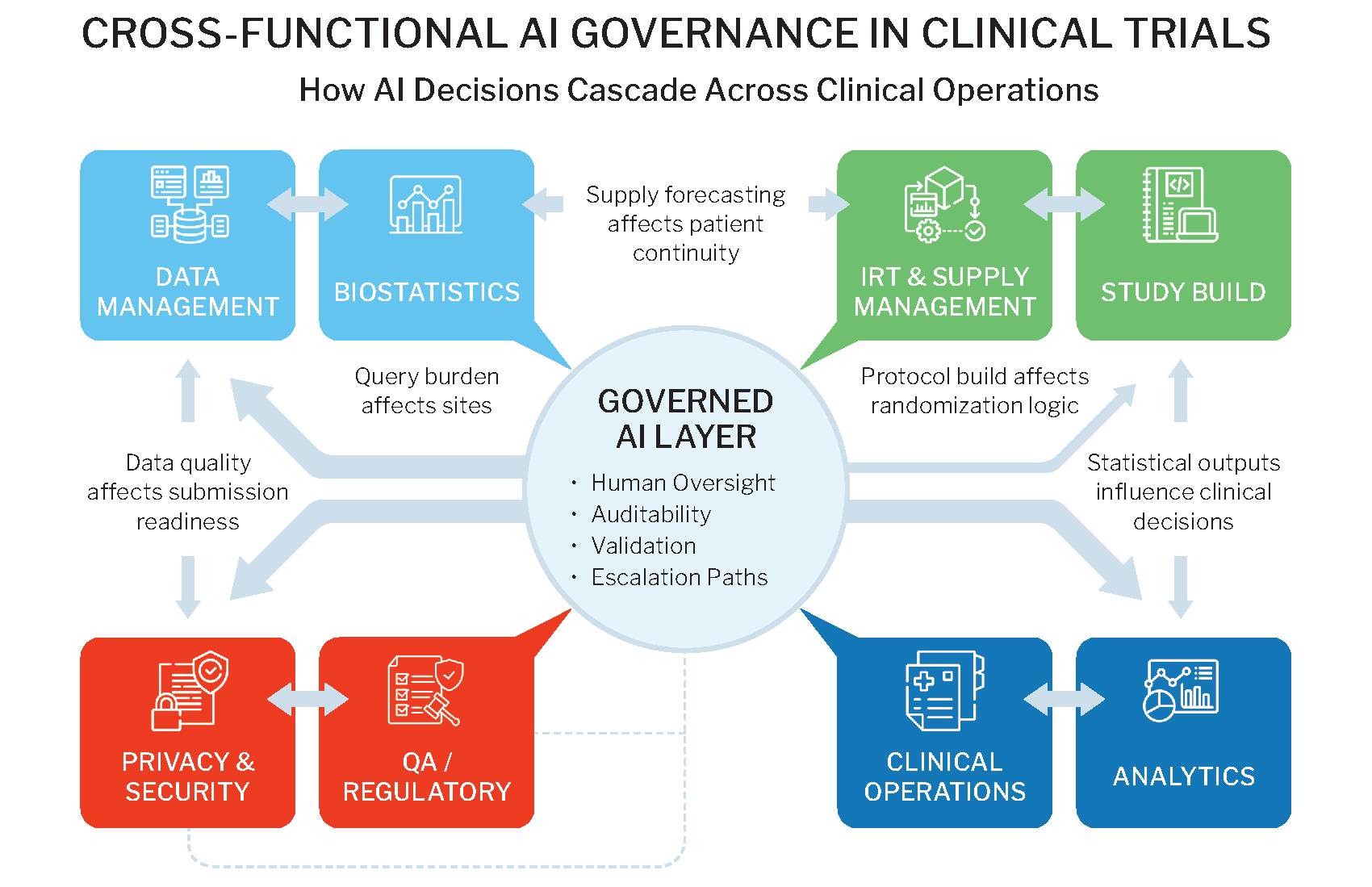
Many AI strategies fail because they approach AI as a collection of isolated tools: a coding assistant in one workflow, a query generator in another, a forecasting model somewhere else. Clinical trials do not operate that way. Decisions made during study build can affect supply forecasting. Supply recommendations can influence patient continuity. Data queries can affect site burden. Statistical signals can shape clinical analysis. A model may perform well within a single workflow, but its real test comes when its outputs begin influencing decisions across study build, supply management, data review, statistical interpretation, and patient-facing operations.
Credible AI adoption requires more than functional tools. It requires an integrated model in which systems, workflows, data quality, validation, and human review operate together rather than independently.
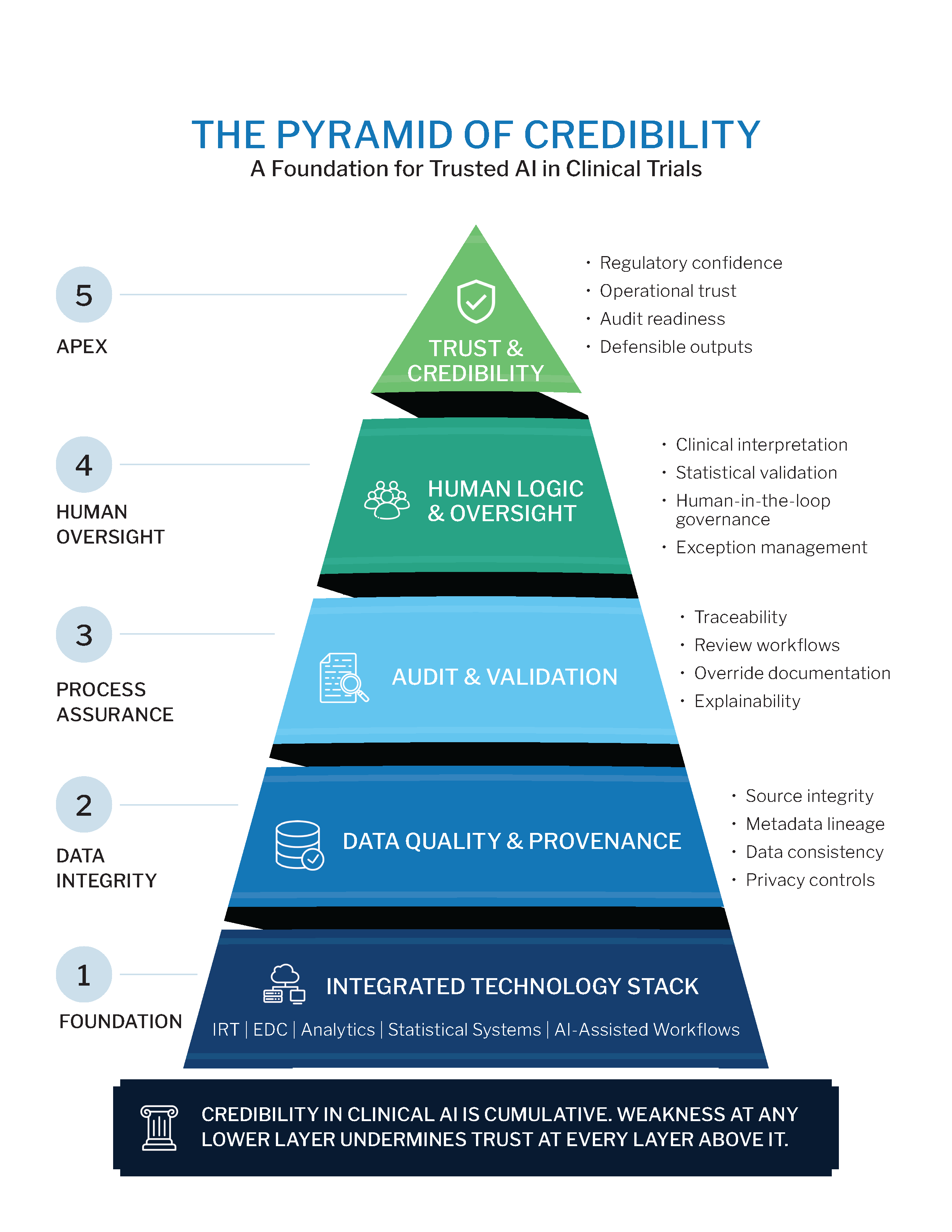
At the foundation sits the integrated technology stack: IRT, Electronic Data Capture (EDC), analytics, statistical programming, and AI-assisted workflows that must support reliable and traceable data flow across the study environment. Above that is data quality and provenance, because AI outputs are only as defensible as the data behind them. The next layer is audit and validation, where machine-generated recommendations must remain explainable, reviewable, and traceable to human approval or override decisions. Human logic and oversight then determine whether AI-generated patterns align with clinical, statistical, and operational reality. Only when those layers are stable can AI outputs earn trust in regulated decision-making.
AI adoption will be constrained by the quality of the data foundation beneath it. Standardized data structures, controlled terminology, metadata discipline, edit check design, coding conventions, and integration architecture become even more important when AI systems are expected to generate recommendations across functions.
In clinical research, the most credible AI use cases are not those that remove human decision-making, but those that improve the quality, consistency, and timeliness of human decisions.
This hierarchy reflects the way AI pressure tests every layer of trial execution. A tool may perform well in a controlled demonstration, yet still fail under the systems, workflows, and operating conditions of a live clinical trial.
THE SHIFT AWAY FROM MANUAL CLINICAL OPERATIONS
For sponsors, the question is not whether a CRO is experimenting with AI, but whether the partner can demonstrate how AI-assisted workflows are governed, validated, documented, and integrated into study execution. In this environment, credible AI becomes a sponsor assurance model: improving speed and risk visibility while preserving regulatory confidence and human accountability.
For decades, many clinical data workflows depended on labor-intensive review. Data managers scanned extensive listings to identify inconsistencies. Statistical programmers spent considerable effort developing initial code structures and repetitive programming elements. Study build teams spent weeks constructing User Acceptance Testing (UAT) scripts and translating protocols into operational specifications. AI is now compressing many of those activities where it strengthens existing workflows without adding operational risk.
For Data Management teams, anomaly detection models can review datasets and flag records requiring human attention, moving teams toward an exception-based review model. As Atik Khan, Data Management Leader, described it, the work is shifting away from simply finding discrepancies and toward interpreting
their significance.
The role of the Data Manager is changing. The job is no longer finding the error. The job is interpreting the error, understanding the context, and deciding whether it represents noise, process failure, or clinical risk.
— Atik Khan, Data Management Leader
That distinction matters. AI’s value is not simply that it performs tasks faster. It changes the allocation of human expertise, allowing clinical professionals to spend less time on repetitive review and more time evaluating the significance, context, and downstream impact of what AI identifies.
In Biostatistics, AI-assisted tools can accelerate the creation of Tables, Listings, and Figures by generating initial code drafts and reducing repetitive programming tasks. AI may also assist with first drafts of Statistical Analysis Plans, mock shells, and other study documentation. This allows biostatisticians and statistical programmers to focus more of their effort on validating logic, refining methodology, and ensuring that outputs are statistically sound and clinically meaningful. Victoria Oliver, Biostatistics Leader, described this evolution directly: “AI can help accelerate coding, documentation, and analysis workflows, but accountability still rests with the expert, not the algorithm.”
AI also creates opportunities earlier in the trial lifecycle. Synthetic datasets can be used to pressure-test Statistical Analysis Plans before real patient data are available, helping statisticians identify structural flaws, validate shells, and test analysis logic earlier than traditional workflows allow.
In IRT and study build environments, AI can move teams from manual transcription toward intelligent extraction, with large language models drafting initial IRT requirements from the protocol. However, AI is pattern-based rather than context-aware. Experts must still identify complex titration rules, randomization exceptions, and skip-logic errors.
The operational implications include shorter validation cycles, faster query turnaround, earlier identification of inconsistencies, improved prioritization of human review effort, and earlier visibility into operational risk.
FOUR SIGNALS OF AN EXECUTABLE DEVELOPMENT PROGRAM

FOUR OPERATIONAL REALITIES OF CREDIBLE AI
Credible AI adoption looks different across clinical functions. The common thread is not automation itself, but whether AI can be integrated, validated, and governed inside actual trial workflows.
Analytics: Practicality over magical thinking
From an analytics perspective, the test is not whether a team can build a model in isolation. It is whether that model can function inside the inconsistent, multi-system environment of a clinical trial. A model that performs well in a vacuum may struggle when exposed to inconsistent data structures, site variability, and the friction of a live study. That distinction moves AI out of innovation and into operational proof.
IRT and Study Build: From manual transcription to intelligent extraction.
AI can help compress the path from protocol interpretation to operational readiness by assisting with protocol extraction, initial specifications, and UAT testing. Risk becomes concrete when AI misses a titration rule, misreads randomization logic, or optimizes supply too aggressively. Predictive supply management can improve continuity and reduce waste, but only if forecasting logic is transparent and final release decisions remain under human oversight.
Data Management: From cleaner to quality architect.
In Data Management, AI is shifting the role from exhaustive manual review toward exception management and workflow design. Anomaly detection can identify the “needles,” while auto-query generation and coding support can reduce repetitive work. The Data Manager still needs to determine whether an exception represents noise, a data entry issue, a site behavior pattern, or clinical risk. The role becomes less about manual cleaning and more about supervising AI-assisted quality architecture.
Biostatistics:The bilingual statistician.
In Biostatistics, AI can support programming and documentation activities by generating draft code, mock shells, and analysis content. The critical skill remains the ability to evaluate the logic and output, verify alignment with the protocol and Statistical Analysis Plan, and apply sound statistical judgement. AI may provide a starting point, but responsibility for the analysis, results, and interpretation remains with the statistician.
AI can generate a reasonable starting point, but it cannot determine whether an analysis approach is appropriate for the study objectives, whether the assumptions are valid, or whether the conclusions are clinically meaningful. That responsibility remains with the statistician.
— Victoria Oliver, Biostatistics Leader
THE REAL CHALLENGE IS TRUST
In regulated clinical environments, AI-generated outputs cannot function as black boxes. A model may identify an outlier, suggest a subgroup analysis, generate a coding recommendation, or predict supply demand, but its value remains limited unless the recommendation can be validated, explained, audited, and governed over time. AI-assisted workflows should not be validated once and then assumed to remain fit for purpose. Changes to source data, protocol amendments, system integrations, model behavior, prompts, or review thresholds must be assessed, documented, and controlled over the life of the study.
That is where many AI conversations become disconnected from clinical reality. Outside regulated industries, AI success is often measured by speed, convenience, or automation volume. In clinical research, teams must be able to demonstrate not only what the system produced, but how the output was generated, why it was accepted or rejected, and who remained accountable for the decision.
From a biostatistics perspective, one risk is placing too much confidence in AI-generated output. While AI can accelerate analysis and generate useful starting points, statisticians remain responsible for determining whether the methods, results, and interpretations are scientifically and clinically credible.
The same issue appears in Data Management. An AI-generated query or coding suggestion may appear reasonable on the surface, but auditors and regulators still require clear documentation of how the decision was made. A parallel risk is “hallucinated cleanliness”: AI-assisted review may make a dataset appear cleaner than it is if missingness, site behavior patterns, coding inconsistency, or upstream process failures are not recognized by experienced reviewers. Defensible outputs depend on an explicit handshake between machine-generated suggestion and human approval: what AI recommended, who reviewed it, why it was accepted or overridden, and how that decision was documented.
For privacy and data governance teams, provenance adds another layer. As clinical organizations explore synthetic data, generative AI, and AI-enabled workflows, the data behind the model must be traceable, anonymized where appropriate, and monitored carefully over long trial lifecycles. These concerns mirror long-standing FDA expectations that electronic source data be reliable, attributable to authorized data originators, traceable through audit trails, and suitable for inspection.
The risk isn’t that AI gets something obviously wrong. It’s that it produces something that looks reasonable enough not to be questioned.
— Victoria Oliver, Biostatistics Leader
HUMAN-IN-THE-LOOP
One of the clearest patterns in credible AI adoption is the rejection of fully autonomous workflows in critical areas of clinical operations. That is not a rejection of technology. It is recognition that clinical trials require accountable decision-making structures.
In Biostatistics, statisticians remain responsible for verifying methodology, validating interpretation, and ensuring clinical relevance. In Data Management, override processes and audit documentation keep AI-generated recommendations reviewable. In IRT workflows, human review-and-release checkpoints remain non-negotiable safeguards before shipments are finalized. Raul Lopez, IRT and Trial Technology Leader, described full automation of drug release as a clear boundary condition.
The same principle applies in analytics. If AI flags a large number of issues and only a subset ultimately prove meaningful, that is not necessarily a failure. Transparent human review is what separates signal from noise before outputs become operational guidance.
“Human-in-the-loop” should not be treated as a slogan. In clinical research, human oversight is a working control system. It validates logic, identifies contextual errors, manages exceptions, preserves inspection readiness, and keeps accountability attached to regulated decisions.
That expectation is increasingly reflected in regulatory guidance. FDA’s risk-based credibility framework and ICH E6(R3)’s emphasis on oversight and critical thinking point in the same direction: automation may support trial execution, but accountable humans remain responsible for the quality and reliability of the process. In many cases, human review becomes more important as AI systems become more capable. A highly confident but flawed recommendation may be more dangerous than a visibly uncertain one.
If someone suggests fully automating drug release without human review, the conversation is over immediately. In regulated environments, human accountability cannot disappear from critical operational decisions.
— Raul Lopez, IRT and Trial Technology Leader
WHEN AI BREAKS THE SILO
The greatest challenge to credible AI adoption may not be the technology itself. It may be the department silo.
AI increasingly acts as connective tissue across functions that clinical organizations have historically managed separately. Decisions made in study build can affect supply forecasting, site burden, data quality, statistical analysis, and operational risk downstream.
That interconnectedness creates value, but it also creates new points of exposure. A model may perform well within one workflow, but credibility depends on what happens when its outputs begin shaping decisions across the larger trial environment.
Credible AI adoption therefore requires cross-functional review before systems go live. Teams need visibility into how AI-generated recommendations are produced, reviewed, overridden, documented, and escalated. For sponsors, governed AI becomes operationally meaningful when it delivers earlier visibility into risk, cleaner execution, and better decision support while preserving clear accountability for how AI is applied, reviewed, and documented.
CONDITIONS FOR CREDIBLE AI DEPLOYMENT
The practical question is no longer whether a clinical partner uses AI. The more important question is whether AI is being deployed in a way that can withstand operational and regulatory scrutiny.
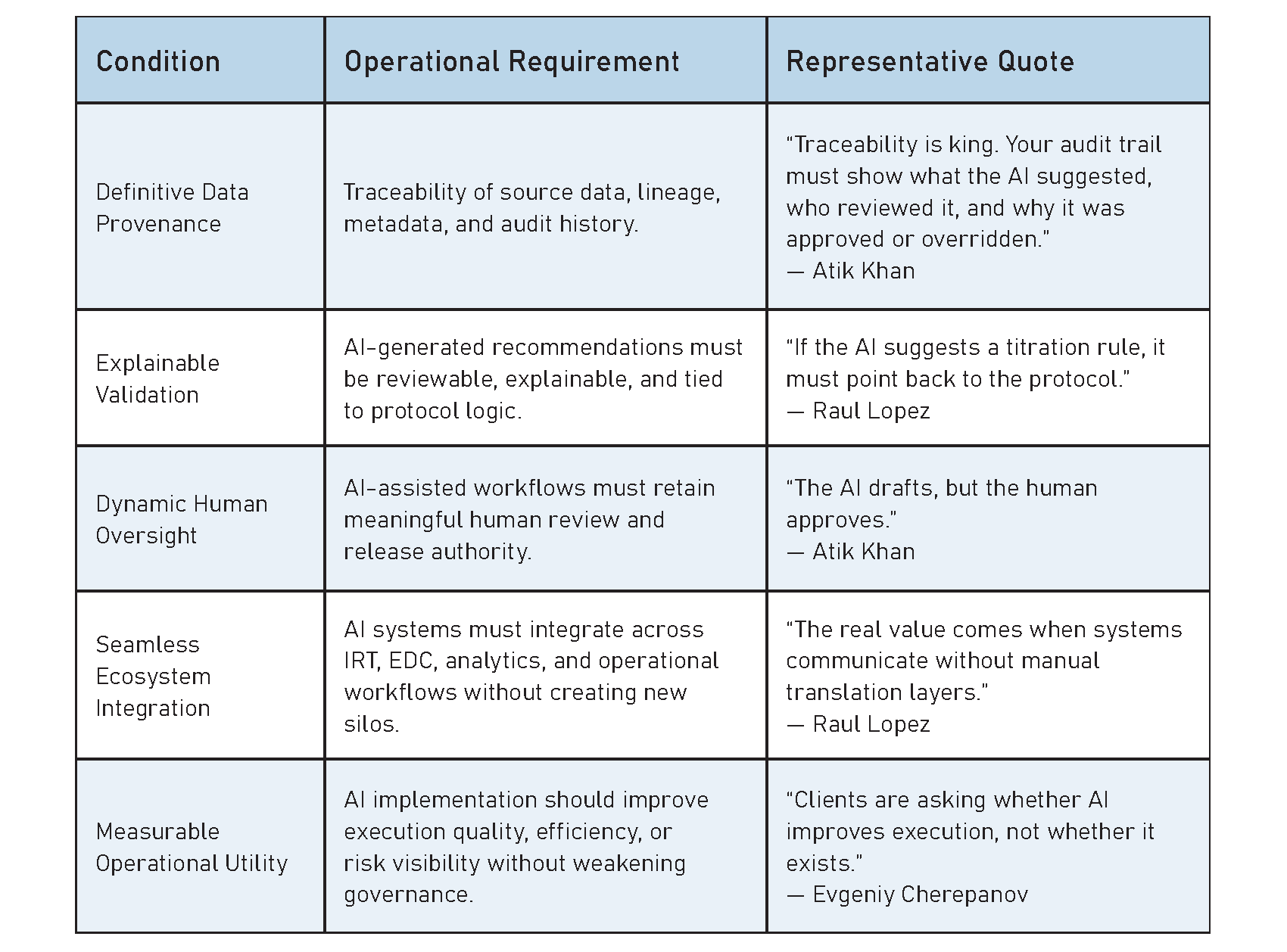
Across clinical development, several operational conditions consistently separate credible AI deployment from surface-level AI positioning.
Operational Requirements for Trusted AI in Clinical Research
THE FUTURE OF CLINICAL AI IS OPERATIONAL, NOT THEORETICAL
The future of AI in clinical trials will likely be less dramatic than many early predictions suggested and far more useful, with the most meaningful gains coming from targeted improvements in workflow efficiency, validation speed, review quality, risk identification, supply forecasting, and decision support.
These changes do not eliminate the need for experienced clinical professionals. They change where expertise is applied. The future clinical data professional may spend less time manually reviewing listings and more time evaluating patterns, interpreting anomalies, auditing machine-generated logic, and designing review workflows. That may ultimately become AI’s most important contribution to clinical research: not the removal of human expertise, but the elevation of it.
The AI strategies that endure will likely be the ones that integrate quietly into clinical operations, strengthen decision-making without obscuring accountability, and improve execution without compromising trust. In regulated research environments, credibility will determine which approaches survive long after the early hype cycle fades.

CONTRIBUTOR PERSPECTIVES
Atik Khan: Data Management leader with experience in AI-assisted review workflows, query governance, and operational data quality.
Victoria Oliver: Biostatistics leader focused on the responsible use of AI to improve efficiency while ensuring statistical rigor, scientific integrity, and regulatory readiness.
Raul Lopez: Trial technology and IRT specialist with experience in protocol interpretation, supply management, and operational systems integration.
Evgeniy Cherepanov: Trial technology and IRT specialist with experience in protocol interpretation, supply management, and operational systems integration.
Elizabeth Scheidt: Project Manager and data analyst focused on explainability, auditability, and regulated AI oversight.
Prashant Shinde: Data governance and privacy leader focused on ensuring trust, traceability, and compliance through data provenance, synthetic data strategy, and responsible AI implementation.
1.Food and Drug Administration. Consider-ations for the Use of Artificial Intelligence to Support Regulatory Decision-Making for Drug and Biological Products: Draft Guidance for Industry and Other Interested Parties. U.S. Department of Health and Human Ser-vices, Jan. 2025.
2.International Council for Harmonisation. ICH Harmonised Guideline: Good Clinical Practice E6(R3). ICH, Jan. 2025.
3.Food and Drug Administration. Consider-ations for the Use of Artificial Intelligence to Support Regulatory Decision-Making for Drug and Biological Products: Draft Guidance for Industry and Other Interested Parties. U.S. Department of Health and Human Ser-vices, Jan. 2025.
4. Food and Drug Administration.Electronic Source Data in Clinical Investigations: Guid-ance for Industry. U.S. Department of Health and Human Services, Sept. 2013.
